
blog.inBrief
Airplane cabin noise and office noise are nothing alike here's why your earbuds' ANC feels so much stronger at 35,000 feet than at your desk.
If you've ever tested the same pair of earbuds both on a flight and at your desk, you've probably noticed a real gap in how well ANC performs. That's not just an impression — the noise itself is fundamentally different in the two places, and ANC was built to handle one of them far better than the other.
Airplane noise: steady, low, and predictable
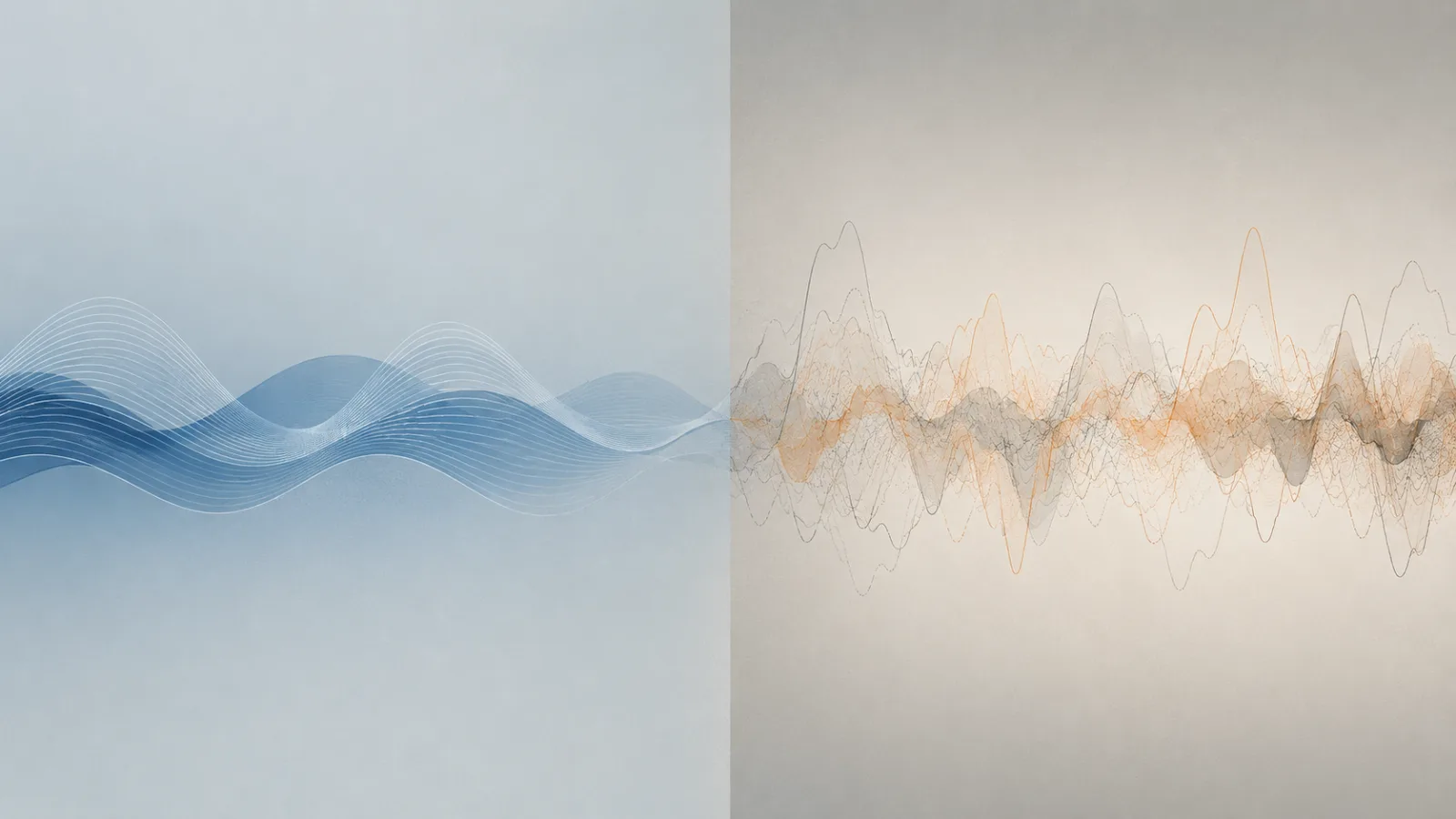
Cabin noise in flight is close to a best-case scenario for active noise cancellation. It's continuous and dominated by low frequencies — engines, airflow around the fuselage, the auxiliary power unit — and it barely changes shape once cruising altitude is reached. Many cabins even carry a persistent low-frequency tone around 100 Hz, tied to blade-passage frequency and its harmonics. That kind of steady, repeating signal is exactly what a cancellation algorithm can model accurately and neutralize with a matching anti-noise wave, which is why the effect on a plane can feel almost dramatic.
Built for the job: hybrid design and adaptive sensing
Aviation-grade ANC rarely relies on active cancellation alone. The dominant approach pairs a passive attenuation floor — the physical seal of the earcup or tip, which handles mid and high frequencies on its own — with active electronics that reach down into the low-frequency range engines and propellers produce. On top of that, some systems track head movement in real time and adjust their filtering as the acoustic path between the noise source and your ear shifts, something a purely passive design simply can't do. In cabins, this is often backed by several microphones covering different zones of the space, so the system can keep tailoring cancellation as conditions around a passenger change.
Why office noise fights back
An open-plan office is close to the opposite of a cabin acoustically. Instead of one steady low-frequency source, you get a shifting mix of conversations, keyboard clicks, ringing phones, chairs scraping, and printers starting up — mostly at higher frequencies than engine noise, and mostly unpredictable. Real-time ANC needs to detect a noise pattern before it can cancel it; sudden, non-repeating sounds don't give it that window, so attenuation drops right when the room gets distracting. The human voice is a particular weak point for any ANC system, in any setting — its frequency range and rhythm are genuinely hard to model, which is partly why some manufacturers deliberately let voices through rather than fight them, for safety and natural awareness reasons.
The power and fit factor
Two practical constraints add to the gap. ANC needs power, so battery life becomes part of the equation over a full workday in a way it isn't for a few hours of listening. And effectiveness depends heavily on a tight physical seal — leakage around the tip undercuts both the passive floor and the active system's low-frequency work, and fit varies a lot from one ear to the next.
ANC has limits in the air too
None of this makes cabin ANC flawless. Transient noise — turbulence, cabin announcements, galley equipment, the APU running while the aircraft is still on the ground — is handled less predictably than the steady cruise drone. Performance also varies by aircraft model, cabin size, and seat position, since the number and placement of microphones is tuned per configuration rather than universal.
What this means for choosing earbuds
If travel is your main use case, ANC alone will usually deliver a satisfying, consistent result. If a noisy office is the priority, ANC still helps, but it works best paired with good passive isolation — well-fitted tips — rather than relying on active cancellation to do all the work. We've put together dedicated picks for each scenario: best earbuds for travel and best earbuds for the office.
FAQ
Is there ANC specifically tuned for office use? Some models offer several ANC levels or profiles adjustable through a companion app, which can be set closer to the environment instead of relying on one fixed mode.
Does passive isolation matter more than ANC in an office? It plays a real complementary role, especially at the mid and high frequencies where active cancellation is weakest.
Why does ANC feel different from one flight to the next? Cabin noise level and character vary by aircraft model and seat position, which is enough to change how effective the same earbuds feel from one trip to another.
Conclusion
ANC isn't uniformly effective — it excels against the constant, low, predictable noise of an airplane cabin, and struggles more with the varied, unpredictable noise of an office, where voices remain its structural weak point. In a noisy office, ANC works best as a complement to good passive isolation, not a replacement for it. Want to compare models by how well their ANC actually holds up in each environment? Our Finder scores ANC by real evidence across travel, office, traffic, and voices, rather than a single generic rating.
EarbudsTimeline is an independent project. If this article helped you, a free-amount donation always makes my day.
Stay in the loop
New articles and database updates, no spam.