
ANC vs Transparency Mode — The Difference, and When to Use Each
blog.inBrief
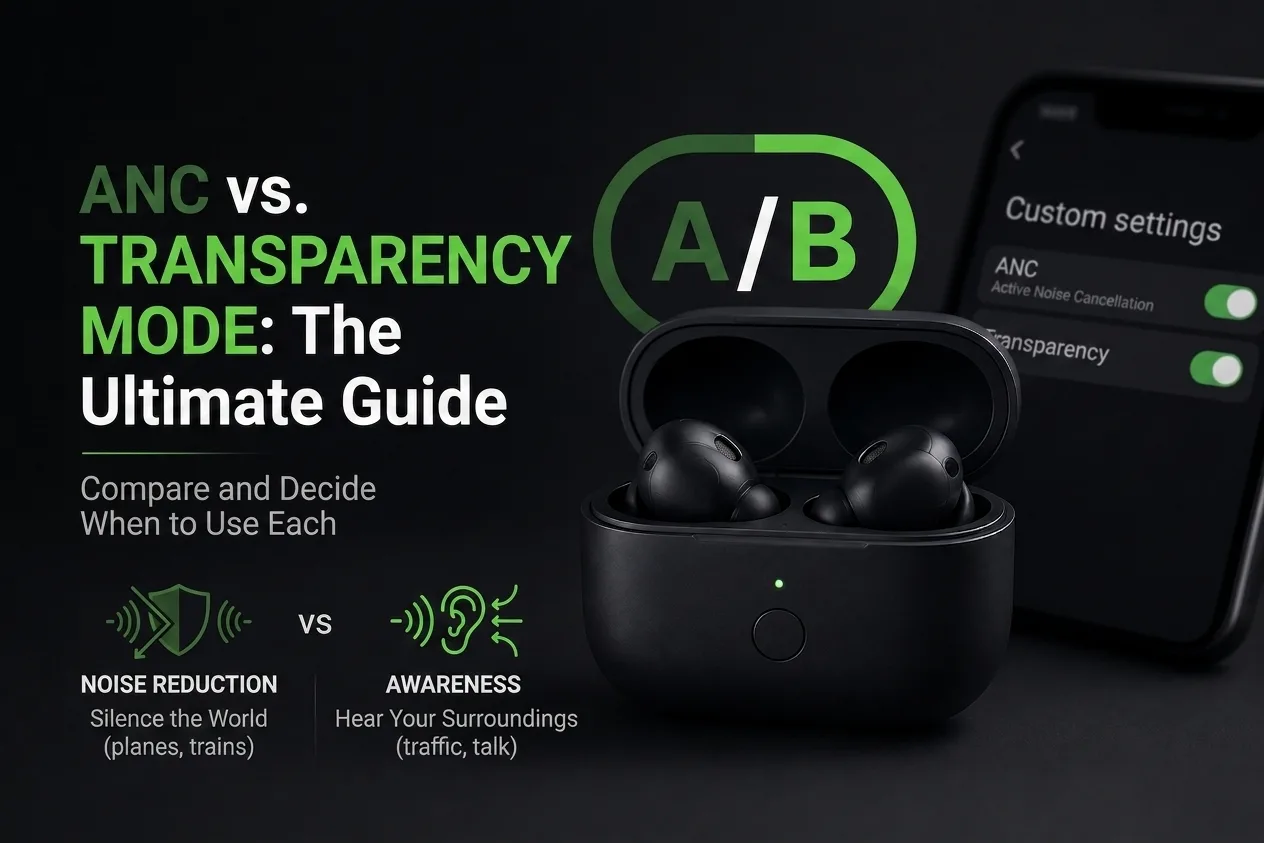
Two opposite features that often get confused — how they work, and which situations call for one over the other.
ANC vs Transparency Mode — The Difference, and When to Use Each
Many wireless earbuds now offer both active noise cancellation (ANC) and transparency mode, often allowing you to switch between them with a button, touch control or companion app.
At first glance, the two features may seem like variations of the same technology. In reality, they have opposite objectives.
ANC tries to make the outside world quieter. Transparency mode tries to bring it back.
Understanding the difference makes it much easier to know which mode to use — and when.
1. Two opposite goals

Active noise cancellation is designed to reduce the amount of ambient sound you hear.
The earbuds use microphones to detect external noise and generate an opposing signal that reduces part of that noise before it reaches your ears. ANC works particularly well against relatively continuous, low-frequency sounds such as aircraft engines, buses, trains and air-conditioning systems.
Transparency mode takes the opposite approach.
Instead of suppressing outside sound, the earbuds use their microphones to capture it and play it back through the speakers. This allows you to hear your surroundings while continuing to listen to music or other audio.
The goal is not to make the earbuds disappear completely, but to make wearing them feel less isolating.
2. Why both rely on the same microphones
ANC and transparency mode often use many of the same microphones.
The hardware doesn't necessarily need to change when you switch between the two modes. What changes is how the earbuds process the microphone signals.
In ANC mode, the system analyzes external noise and generates an opposing signal to reduce it.
In transparency mode, the system processes external sound and feeds it back into the earbuds, often with adjustments to make it sound as natural as possible.
This shared hardware and processing architecture is why switching between the two modes can be almost instantaneous on modern earbuds.
3. When to favor ANC
ANC is most useful when you're surrounded by continuous or predictable background noise.

Good examples include:
✈️ Airplanes
🚆 Trains and buses
🏢 Open-plan offices
☕ Busy cafés
🛫 Airports
🏠 Air-conditioning and other constant background noise
The biggest benefit isn't necessarily silence.
It's that you don't have to turn your music up as much to overcome the surrounding noise. By reducing the background, ANC can make listening more comfortable at a lower volume.
ANC is therefore particularly useful when your goal is focus, isolation or a quieter listening environment.
4. When to favor transparency
Transparency mode becomes more useful when awareness of your surroundings matters.

For example, you might use it when:
🚶 Walking through a city
🚦 Crossing a street
🏃 Running near traffic
🗣️ Speaking briefly with someone
📢 Listening for announcements at an airport or station
👂 Staying aware of what's happening around you
It also eliminates one of the most annoying parts of wearing earbuds: having to remove them every time someone speaks to you.
On well-tuned earbuds, transparency mode can make outside sounds feel relatively natural while your music continues playing in the background.
FAQ
Can you use ANC and transparency mode at the same time?
Not in their conventional forms.
They are fundamentally different processing modes: ANC is designed to reduce external sound, while transparency mode is designed to reproduce it.
Some earbuds may offer additional adaptive or automatic modes that dynamically adjust how much outside sound is allowed through, but that's different from simultaneously running full ANC and full transparency.
Does transparency mode really feel like not wearing earbuds?
On the best implementations, it can feel surprisingly natural.
Good transparency processing attempts to reproduce external sounds without making them feel obviously filtered or electronically altered.
There can still be some coloration compared with listening without earbuds, particularly with voices and higher-frequency sounds. The quality of the microphones, processing and acoustic design all affect how convincing the effect feels.
Do all earbuds with ANC also have transparency mode?
No.
Many modern ANC earbuds offer transparency or ambient-sound modes, but it isn't guaranteed.
If both features matter to you, check for ANC and transparency mode separately in the specifications rather than assuming that one automatically includes the other.
Which mode should I use when walking outside?
Transparency mode is generally the better choice when you need to remain aware of traffic, people, announcements or other environmental sounds.
For situations where awareness is important, don't rely solely on transparency mode: keep the volume reasonable and stay attentive to your surroundings.
Conclusion
ANC and transparency mode often use the same microphones and much of the same underlying hardware, but they perform fundamentally opposite jobs.
ANC reduces the outside world. Transparency mode brings it back.
Use ANC when you're dealing with constant background noise and want to focus on your audio. Use transparency mode when you need to hear what's happening around you without taking your earbuds out.
Neither mode is universally better.
The right choice depends on the situation.
Want to compare models on this criterion? Explore earbuds with transparency mode in our dedicated guide.
EarbudsTimeline is an independent project. If this article helped you, a free-amount donation always makes my day.
Stay in the loop
New articles and database updates, no spam.