
blog.tableOfContents
- 1. The principle: more current, faster
- 2. Why it works better on a nearly empty battery
- What this means in practice
- 3. The trade-off: more heat and chemical stress
- 4. What the case also needs to support
- Does fast charging really damage the battery?
- Why does my fast charging seem slower than advertised?
- Does fast charging also work with wireless charging?
blog.inBrief
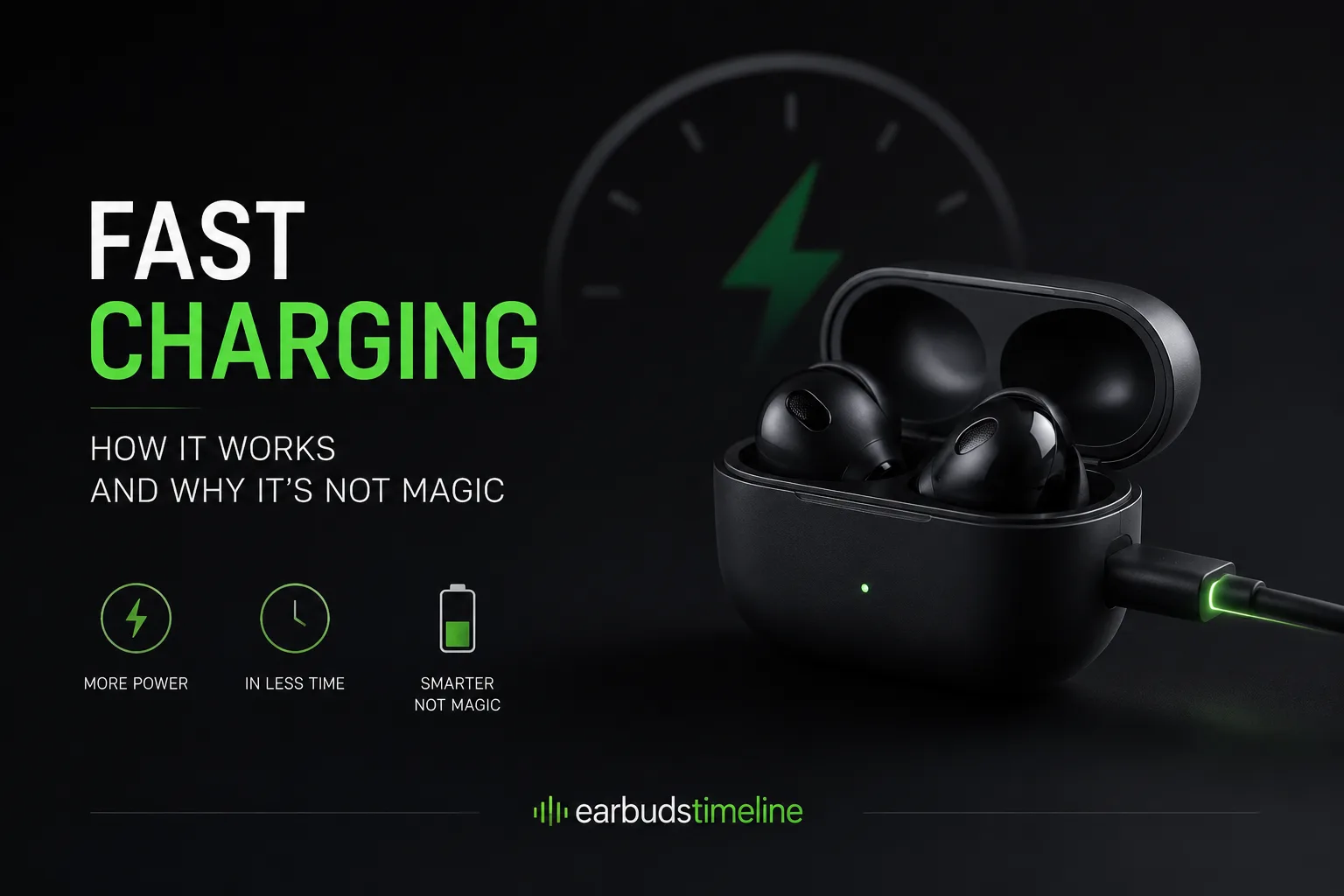
10 minutes of charging for 1-2 hours of listening? Here's the technical principle behind fast charging on earbuds, its physical limits, and why it wears down the battery a bit faster over time.
Fast Charging: How It Works and Why It's Not Magic
A number keeps showing up on recent spec sheets: "10 minutes of charging for 1-2 hours of listening."
Handy on paper, but far from a magic trick — fast charging relies on a very real technical trade-off.
Here's the principle behind that promise, its limits, and why it can slightly speed up battery wear over the long run.

1. The principle: more current, faster

Fast charging works by pushing more current into the battery over a short period, rather than following a more gradual, standard charging curve.
A small-capacity battery, like the one in an earbud, can absorb this higher current for a few minutes without immediate damage, as long as the charging management circuit is properly sized for it.
2. Why it works better on a nearly empty battery

Fast charging is generally most effective in the first few minutes, when the battery is close to zero, and slows down as it fills up — a principle similar to what's seen on smartphones.
That's why the advertised figure ("10 minutes = 1h of listening") is usually based on a fully empty battery, not a partially charged one.
What this means in practice
If your earbuds are already half-charged, a few minutes on the charger won't get you the same amount of listening time as the number on the spec sheet.
3. The trade-off: more heat and chemical stress
Charging faster generates more heat and puts more strain on the battery's internal chemistry.
Over the long term, repeated fast-charging cycles can slightly speed up the degradation of the battery's total capacity compared to slower, more gradual charging — a trade-off most manufacturers consider acceptable given the convenience it offers.
4. What the case also needs to support

Fast charging for earbuds depends as much on the case as on the earbuds themselves.
The case needs to be able to deliver the necessary current, which sometimes means using a specific cable or adapter to actually reach the advertised speed. A charger that's too weak won't get you those numbers.
FAQ
Does fast charging really damage the battery?
Only marginally under normal use.
The cumulative effect over several hundred cycles can slightly speed up degradation, without making the battery unusable prematurely.
Why does my fast charging seem slower than advertised?
The charger or cable you're using may not deliver enough current, or the battery wasn't fully empty at the time.
Does fast charging also work with wireless charging?

Yes, on some models.
Wireless charging is still generally slower than wired charging, even in fast mode.
Conclusion
Fast charging isn't magic: it comes down to a simple trade-off — more current over a short period, working best when the battery is close to empty.
The price is a slightly faster battery wear over the long run — a trade-off most users will find well worth the convenience.
Torn between a few models? Compare them by fast-charging time in our dedicated guide.
EarbudsTimeline is an independent project. If this article helped you, a free-amount donation always makes my day.
Stay in the loop
New articles and database updates, no spam.