
The History of Noise Cancellation, From Bose to True Wireless
blog.tableOfContents
- 1. A technology born outside the consumer market
- 2. Bose and the rise of consumer ANC headphones
- 3. The challenge of miniaturizing it for in-ear designs
- 4. Trickling down to entry-level
- Did Bose invent active noise cancellation?
- Why was aviation the first real-world application?
- Does ANC on today's earbuds match the best headphones?
blog.inBrief
From the first ANC headphones built for airline pilots to miniaturization inside in-ear earbuds — the evolution of a technology that started far from the consumer market.
The History of Noise Cancellation, From Bose to True Wireless
Long before it fit inside earbuds barely larger than a thumb, active noise cancellation (ANC) was developed for a very different purpose.
Its early applications were closely tied to aviation, where reducing constant engine noise could protect hearing and make communication easier for flight crews. Decades later, the same basic technology would become one of the defining features of modern wireless earbuds.
The journey from aircraft cockpits to sub-$50 true wireless earbuds is a story of research, engineering and relentless miniaturization.
1. A technology born outside the consumer market
The foundations of active noise cancellation date back to research conducted in the 1950s.
The basic principle is relatively simple: microphones detect unwanted sound, electronics process that signal, and the system generates an opposing sound wave designed to reduce the original noise.
Putting that principle into a practical product was much harder.
Aviation provided an ideal early use case.

Aircraft engines produce continuous, relatively predictable noise, much of it concentrated in lower frequencies. For pilots and flight crews exposed to that noise for extended periods, reducing it could improve comfort, communication and hearing protection.
Early systems were bulky and specialized, however, and had little resemblance to the compact consumer headphones and earbuds we use today.
2. Bose and the rise of consumer ANC headphones
Active noise cancellation eventually moved beyond specialized applications and into the consumer market.
Bose played a major role in that transition.

Beginning in the 2000s, the company developed and marketed noise-cancelling headphones specifically suited to travelers and everyday consumers.
This helped turn ANC from a relatively obscure engineering concept into a feature that ordinary headphone buyers could understand immediately.
The use case was particularly compelling on airplanes: instead of simply listening to music louder to overcome engine noise, travelers could use ANC to reduce some of that background noise before it reached their ears.
Over time, Bose became closely associated with noise cancellation itself, helping establish ANC as a major category of consumer audio technology.
3. The challenge of miniaturizing ANC for in-ear designs
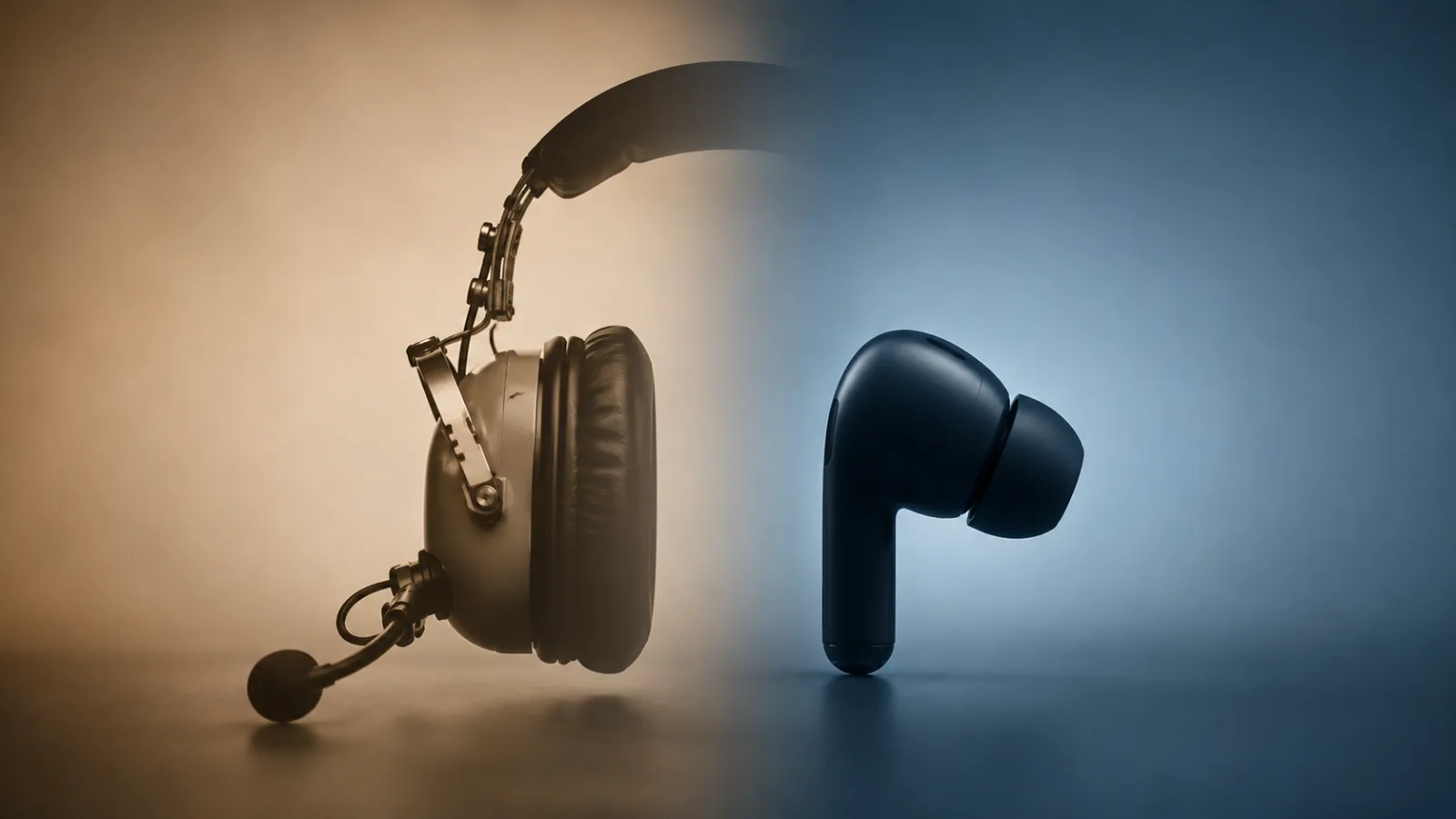
Moving ANC from over-ear headphones into tiny in-ear devices presented an entirely different engineering challenge.
An over-ear headphone has relatively generous space for microphones, processing hardware, batteries and acoustic components. An earbud has to fit many of the same functions into a device that may weigh only a few grams.
Engineers had to miniaturize:
microphones capable of detecting external noise;
signal-processing hardware;
batteries powerful enough to run the system;
acoustic components;
and the electronics required to control everything in real time.
There was another challenge as well: the ear itself became part of the acoustic system.
The effectiveness of ANC depends not only on electronic processing but also on how well the earbud seals the ear canal and how accurately the system responds to the surrounding environment.
The first true wireless earbuds with genuinely effective ANC therefore appeared several years after the true wireless format itself became mainstream.

4. ANC trickles down to entry-level
Once manufacturers became better at miniaturizing the technology, another transformation began: ANC started moving down the price ladder.
Advances in MEMS microphones, increasingly capable processing chips and larger-scale manufacturing made it possible to incorporate active noise cancellation into progressively cheaper products.
What was once a feature associated primarily with premium headphones eventually appeared in affordable true wireless earbuds.
Today, ANC can be found even on models costing under $50.

The result is a familiar pattern in consumer electronics: a technology begins as an expensive or specialized capability, becomes a premium differentiator, and eventually becomes accessible to a much larger portion of the market.
FAQ
Did Bose invent active noise cancellation?
No.
The underlying principles of active noise cancellation predate Bose. Research into the concept goes back decades before the company brought commercial noise-cancelling products to a broad consumer audience.
Bose nevertheless played a major role in popularizing ANC in consumer headphones, particularly for travel.
Why was aviation one of the first real-world applications?
Aircraft generate continuous engine noise, making aviation a particularly suitable environment for early ANC systems.
Constant low-frequency noise can be tiring and can interfere with communication, while reducing it can make long periods around aircraft engines more manageable.
The relatively predictable nature of engine noise also made it a useful target for early noise-cancellation systems.
Does ANC on today's earbuds match the best headphones?
Not necessarily.
Over-ear headphones generally have more physical space for microphones, processing hardware and acoustic components. They also surround the ear with a larger passive-isolation structure.
Modern earbuds can nevertheless deliver impressive ANC performance despite their much smaller size. The gap has narrowed considerably as processing, microphones and acoustic design have improved.
The best choice ultimately depends on the specific product and the type of noise you're trying to reduce.
Conclusion
From aviation research in the 1950s to true wireless earbuds costing less than $50, active noise cancellation has followed a remarkably long path.
It began as a specialized technology for demanding professional environments, became a defining feature of premium consumer headphones, and then faced one of its biggest engineering challenges when manufacturers attempted to fit it into miniature in-ear devices.
Today, that miniaturization has made ANC accessible to almost everyone.
The trajectory isn't finished. As microphones, processors and battery technology continue to improve, the technology will likely keep becoming more capable while moving into increasingly affordable products.
Want to go deeper? Learn how ANC actually works in our dedicated article, or compare today's models in our ANC guide.
EarbudsTimeline is an independent project. If this article helped you, a free-amount donation always makes my day.
Stay in the loop
New articles and database updates, no spam.