
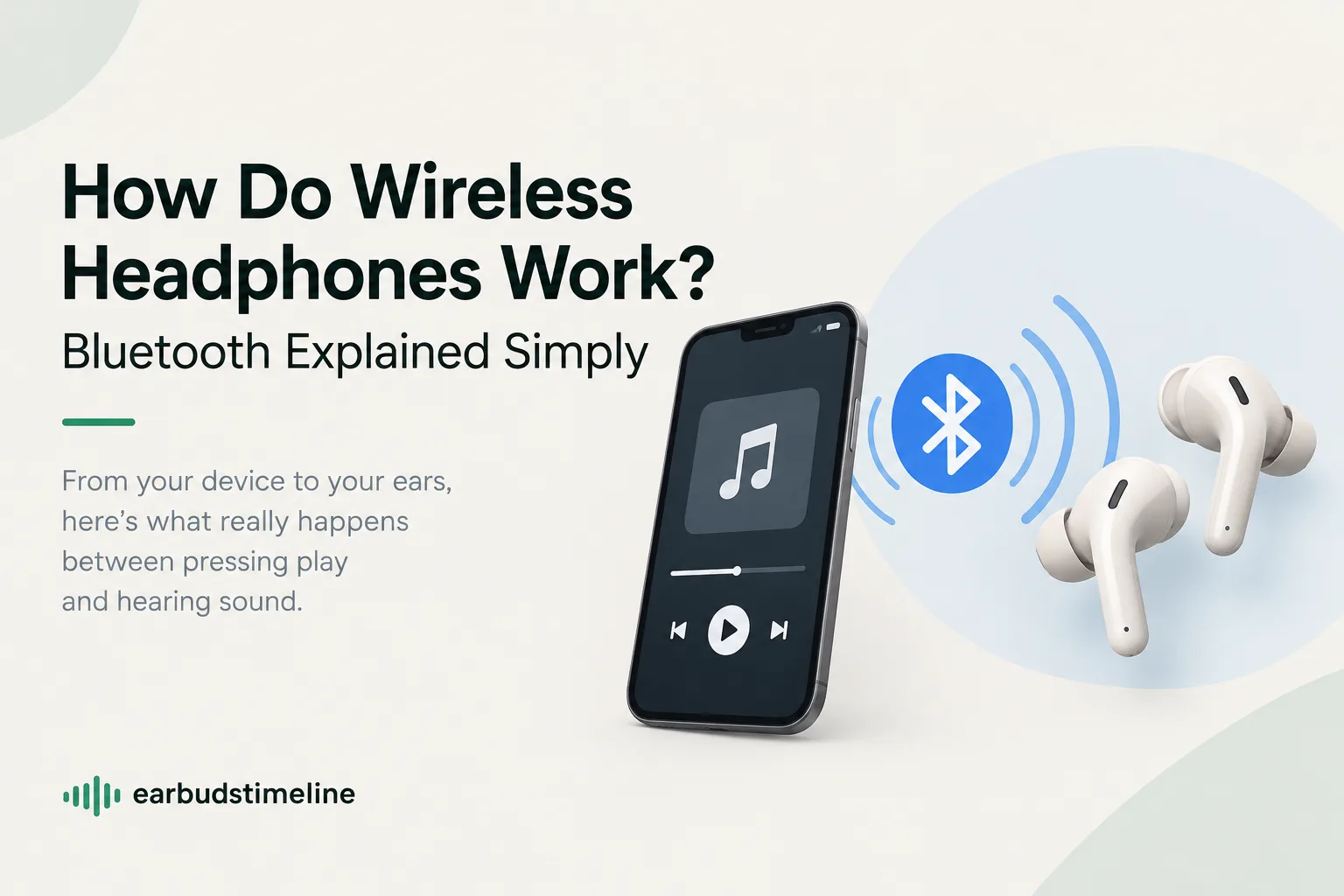
How Do Wireless Headphones Work? Bluetooth Explained Simply
blog.inBrief
A plain-language explanation of how wireless headphones transmit audio, why they need pairing, and what actually happens between your phone and your ears.
How Do Wireless Headphones Work? Bluetooth Explained Simply
Wireless headphones and earbuds almost universally rely on Bluetooth, a short-range radio technology, to receive audio from your phone or computer without a cable. Here's what actually happens between pressing play and hearing sound.
📡 The basic signal path
Your device encodes the audio: Your phone or computer compresses the digital audio file using a Bluetooth audio codec (like SBC, AAC, or aptX) so it can be sent efficiently over a limited-bandwidth wireless connection.
The signal travels over radio waves: Bluetooth operates in the 2.4 GHz radio frequency band — the same general range used by Wi-Fi — sending the compressed audio as a stream of radio signals.
Your earbuds receive and decode it: A small Bluetooth chip inside the earbuds picks up the signal and decodes it back into an audio waveform.
The driver converts it to sound: A tiny speaker (called a driver) inside each earbud vibrates according to that waveform, producing the sound you hear.
This entire round trip happens in milliseconds, which is why the process feels instantaneous even though several conversion steps are involved.
🔗 Why pairing is necessary
Bluetooth devices need to "pair" — a one-time handshake where your phone and earbuds exchange identifying information and agree to trust each other — before they can connect automatically going forward. Once paired, most earbuds reconnect to the last-used device automatically whenever you take them out of the case, without needing to repeat the full pairing process.
🎚️ Why sound quality can vary between devices
Not all Bluetooth connections sound identical, because the codec used affects how much audio detail survives compression:
SBC is the baseline codec every Bluetooth device supports, with the most compression and the most modest audio quality.
AAC is common on Apple devices and improves quality somewhat over SBC.
aptX and LDAC (supported on many Android phones and higher-end earbuds) allow higher bitrates and generally better fidelity, but only when both the earbuds and the source device support the same codec.
If your earbuds support a better codec than your phone does, the connection defaults to whichever codec both devices have in common — usually SBC.
🔋 Where the two-way connection matters
Most true wireless earbuds also need to communicate with each other, not just with your phone. One earbud typically acts as the "primary" that receives the Bluetooth signal directly, then relays it to the second earbud over a separate short-range connection — which is part of why range or connection issues sometimes affect one earbud before the other.
For calls, the process runs in reverse too: your voice is picked up by a microphone in the earbud, compressed, and sent back to your phone over the same Bluetooth connection — which is generally lower-bandwidth than the music path, one reason call audio quality is often noticeably lower than music playback.
EarbudsTimeline is an independent project. If this article helped you, a free-amount donation always makes my day.
Stay in the loop
New articles and database updates, no spam.