
Why Two Earbuds With the Same Codec Don't Sound the Same
blog.tableOfContents
- 1. The codec only carries the information, not the final result
- 2. The role of the digital-to-analog converter (DAC)
- 3. The driver: the part that physically produces the sound
- 4. Acoustic tuning: a deliberate choice by the manufacturer
- Does the codec still influence part of the result?
- Can you improve the sound without changing earbuds?
- Does price reflect the quality of the DAC and driver?
blog.inBrief
The codec is just one step in the signal's journey — the driver, DAC, amplification, and acoustic tuning explain the rest of the difference.
Why Two Earbuds With the Same Codec Don't Sound the Same
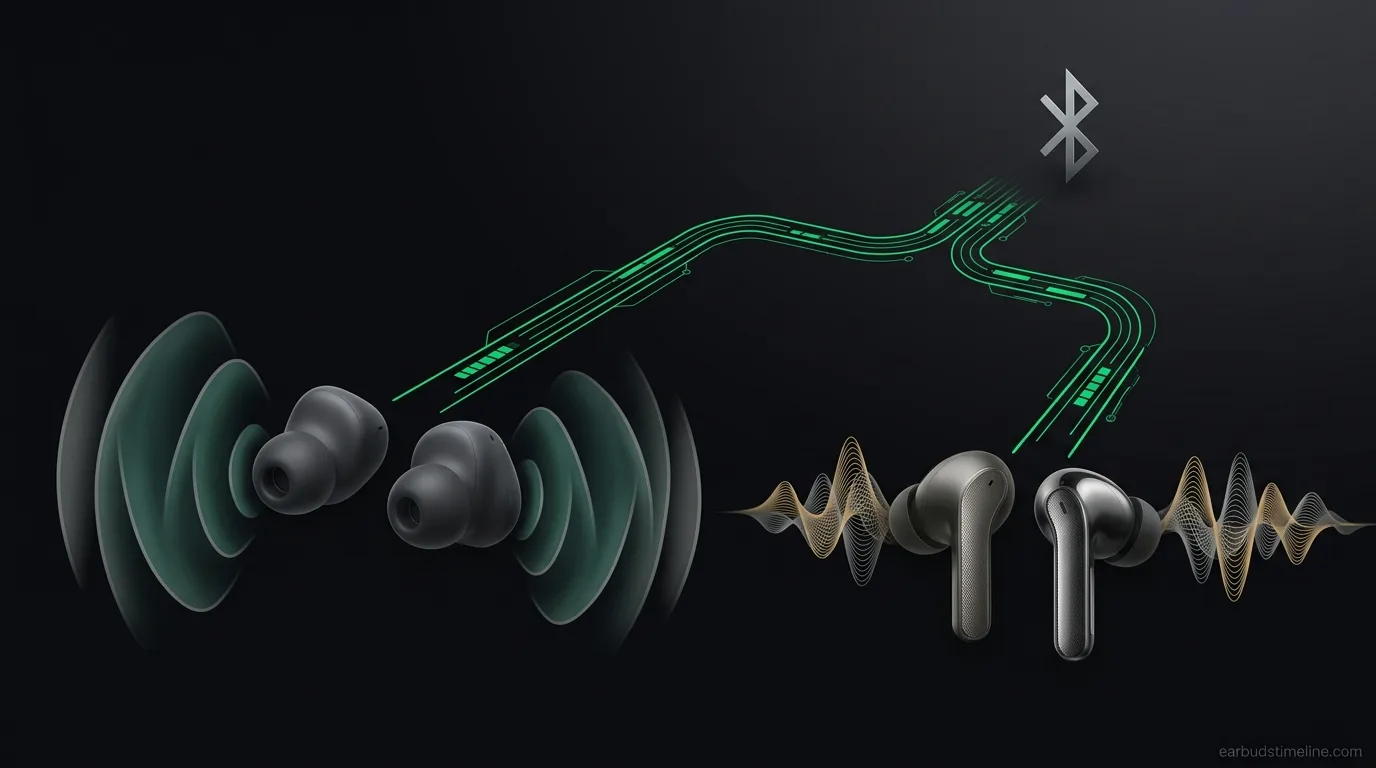
Two earbud models supporting the exact same Bluetooth codec — for example, AAC — can sound remarkably different.
That's not a contradiction. A codec is only one part of the audio chain. What you ultimately hear depends on everything that happens before, during and after the digital signal reaches the earbuds.
1. The codec only carries the information, not the final result
A Bluetooth codec determines how audio is encoded, compressed and transmitted from your device to the earbuds.
It therefore has an influence on how much information survives the wireless transmission and how much compression is applied along the way.
But the codec doesn't determine what the earbuds will ultimately sound like.
Once the signal reaches the earbuds, it still has to pass through several other stages: digital processing, conversion, amplification and, finally, the speaker itself.
Two earbuds can therefore receive essentially the same encoded audio stream and produce very different results.
2. The role of the digital-to-analog converter (DAC)
The DAC — digital-to-analog converter — converts the digital audio signal into an analog electrical signal that the rest of the audio hardware can use.
Its implementation can differ significantly between manufacturers and products.
But the DAC shouldn't be treated as the single component responsible for sound quality. Its performance is only one part of the overall electronic and acoustic design, alongside the amplifier, driver and signal processing.
In a well-designed pair of earbuds, these components work together as a system.
3. The driver: the part that physically produces the sound
The driver is the miniature speaker inside the earbud. It's ultimately responsible for converting the electrical signal into physical movement that produces sound waves.
This is one of the most important factors shaping what you actually hear.
Driver size, materials, construction and architecture can all influence the result. A traditional dynamic driver, for example, behaves differently from a balanced-armature driver, while hybrid designs combine multiple driver types.
That's why two earbuds using the same codec can have completely different bass response, vocal reproduction and treble characteristics.
The codec is upstream. The driver is where the electrical signal becomes physical sound.
4. Acoustic tuning: a deliberate choice by the manufacturer
Even identical components don't guarantee an identical sound signature.
Manufacturers make deliberate tuning decisions to shape the final frequency response. One pair might emphasize deep, powerful bass, another might aim for a more neutral presentation, while a third might prioritize brighter treble and greater perceived detail.
The acoustic chamber, ear-tip design and physical shape of the earbud also influence how the driver interacts with your ear.
This is why sound quality isn't simply a matter of checking which codec appears on the specification sheet.
The final sound is the result of the entire system.
FAQ
Does the codec still influence the final sound?
Yes.
The codec can affect the amount of audio information transmitted and the artifacts introduced during compression. Differences can become more relevant depending on the codec, bitrate, source material and listening conditions.
But the codec represents only one stage of the complete audio chain.
Can you improve the sound without changing earbuds?
To some extent.
If the manufacturer's companion app includes an equalizer, you can adjust the frequency balance to change the perceived sound. Increasing or reducing bass, mids or treble can make a significant difference.
However, an EQ cannot fundamentally change the physical characteristics of the driver or the acoustic design.
Does price reflect the quality of the DAC and driver?
Sometimes, but not proportionally.
More expensive earbuds may use more sophisticated components, better drivers or more advanced signal processing. But price also reflects other factors such as materials, software, ANC performance, design, brand positioning and development costs.
A higher price therefore doesn't automatically mean a better DAC or a better-sounding driver.
See our article on the link between price and quality.
Is a better codec more important than a better driver?
Generally, not by itself.
Once you're using a codec that provides sufficiently good transmission quality for your listening conditions, the rest of the audio chain can have a much larger influence on the character of the sound.
That's why looking only at codec support is a poor way to predict how a pair of earbuds will sound.
Conclusion
The codec determines how audio information is encoded and transmitted. It doesn't determine what happens once that signal reaches the earbuds.
The DAC, amplifier, driver, acoustic design and tuning all contribute to the final result.
That's why two earbuds supporting exactly the same codec can legitimately sound completely different — and neither one has to be doing anything wrong.
When comparing earbuds, codec support is worth considering, but it shouldn't be treated as a shortcut for predicting sound quality.
Want to understand the technology behind Bluetooth audio? Explore our complete guide to Bluetooth codecs.
EarbudsTimeline is an independent project. If this article helped you, a free-amount donation always makes my day.
Stay in the loop
New articles and database updates, no spam.