
USB-C vs Wireless Charging — The Real Impact on Battery Life
blog.tableOfContents
- 1. Neither one changes the battery's capacity
- 2. Where wireless charging loses efficiency
- 3. What USB-C actually changes: convenience, not performance
- 4. What wireless charging actually changes: no cable at all
- Can a case have both?
- Does wireless charging wear the battery down faster than USB-C?
- Why do some cases still not have USB-C?
blog.inBrief
Neither USB-C nor wireless charging changes the earbuds' own battery life — here's what they actually change, and where wireless charging loses efficiency.
USB-C vs Wireless Charging — The Real Impact on Battery Life
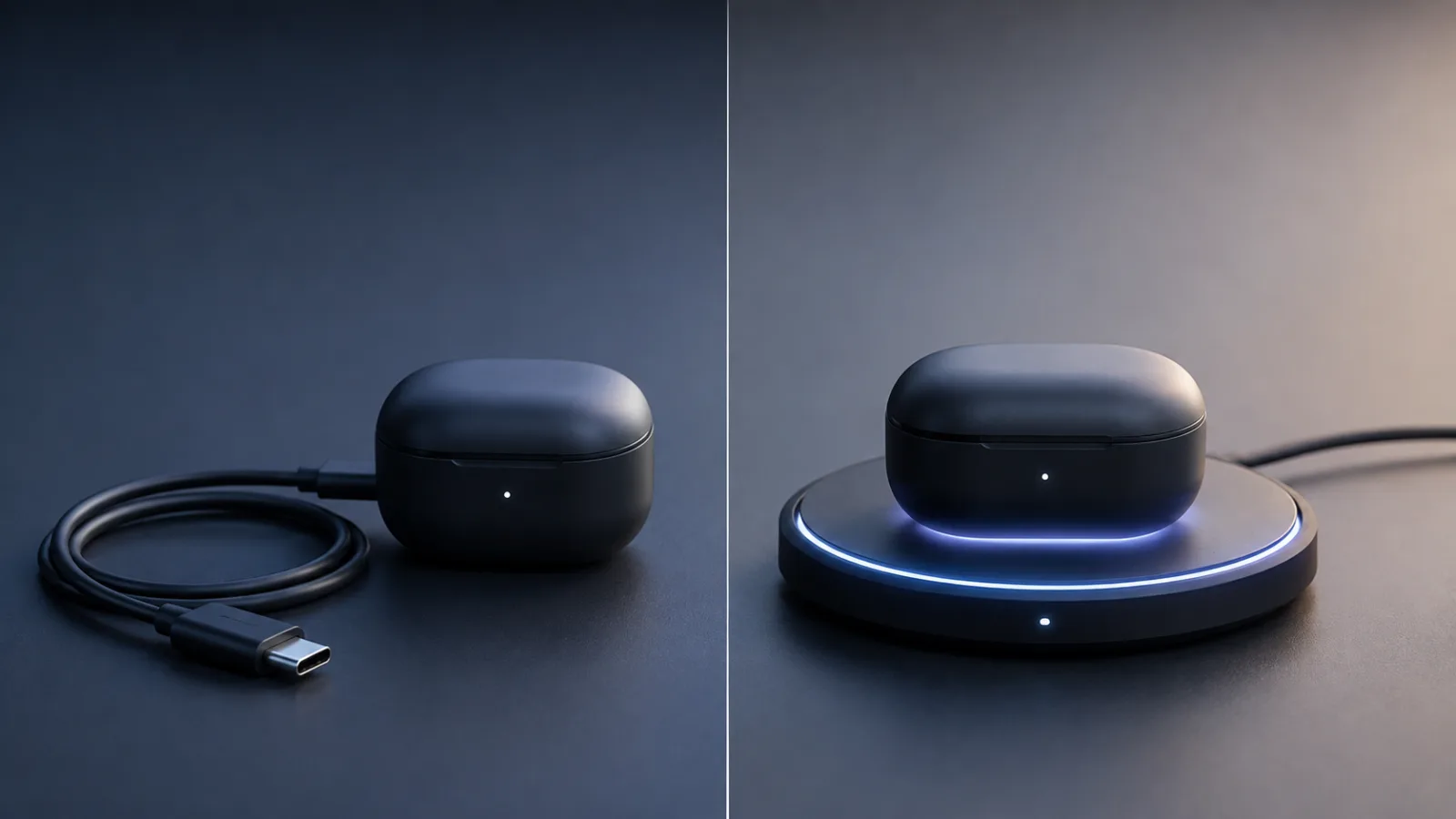
USB-C and wireless charging are often presented as competing features.
In reality, they solve different problems. Both can keep your earbuds charged, but the choice between them affects charging speed, convenience and efficiency more than it affects the battery's capacity or listening time.
1. Neither one changes the battery's capacity

The charging method doesn't determine how much energy the battery can store.
Whether a charging case uses USB-C, wireless charging, or both, its battery capacity remains a property of the battery itself. Once the case and earbuds are fully charged, the available listening time is determined by the battery capacity and the earbuds' power consumption — not by how the energy got there.
USB-C and wireless charging are simply two different ways of transferring energy into the charging case.
2. Where wireless charging loses efficiency
Wireless charging uses electromagnetic induction to transfer energy between the charging pad and the case.
That process isn't perfectly efficient. Some energy is lost during the transfer, primarily as heat, which means wireless charging generally requires more input energy than wired charging to deliver the same amount of stored energy.

It can also be slower, depending on the charging system and the power supported by the case and charger.
For a quick top-up before leaving home, USB-C is generally the more practical option. Plugging in the case is straightforward, efficient and usually faster.
Wireless charging makes a different trade-off: less effort in exchange for a less direct charging process.
3. What USB-C actually changes: convenience
The biggest advantage of USB-C isn't that it magically improves the battery.
It's compatibility.
A single USB-C cable can often be used for your earbuds, smartphone, tablet, laptop and other accessories. That means fewer different cables to carry and fewer proprietary connectors to keep track of.
USB-C can also make charging easier when you're already carrying a compatible charger or power bank.
So while USB-C can offer practical advantages in charging speed and efficiency, its biggest everyday benefit is simply that it's a widely adopted standard.
4. What wireless charging actually changes: no cable
Wireless charging takes the opposite approach.
Instead of plugging a cable into the case, you simply place it on a compatible charging pad.

That makes it particularly convenient for people who charge their earbuds at a desk, bedside table or other fixed location. There is no connector to plug in and no cable attached to the case while it charges.
The trade-off is that wireless charging is typically less efficient and can be slower than wired charging.
In other words, you're not choosing between two fundamentally different battery technologies.
You're choosing between cable-based convenience and cable-free convenience.
FAQ
Can a case have both USB-C and wireless charging?
Yes.
Many charging cases support both wired charging through USB-C and wireless charging through a compatible standard such as Qi.
That gives you the flexibility to use a cable when you need a quick charge and wireless charging when convenience matters more.
Does wireless charging wear the battery down faster than USB-C?
Potentially, but the difference is generally small under normal use.
Wireless charging can generate additional heat, and heat is one of the factors that can accelerate lithium-ion battery degradation. However, the actual impact depends on the charging system, thermal management, charging habits and operating conditions.
For most users, the convenience of wireless charging is unlikely to make a dramatic difference to the useful life of an earbud battery.
Why do some cases still not have USB-C?
Because manufacturers don't update every product at the same time.
Older models may continue using Micro-USB or another connector while they remain in production or on sale. Newer models increasingly use USB-C as it has become the dominant connector standard across consumer electronics.
The absence of USB-C therefore doesn't necessarily indicate poor charging performance — it may simply reflect the age of the design.
Is USB-C always faster than wireless charging?
Not automatically.
Charging speed depends on the charging hardware inside the case, the charger, the cable and the power limits supported by the product.
However, when comparing otherwise similar systems, wired USB-C charging generally has an efficiency and speed advantage over conventional inductive wireless charging.
Conclusion
USB-C and wireless charging don't fundamentally change the battery capacity of wireless earbuds or the listening time available once they're fully charged.
They simply offer two different ways of getting energy into the charging case.
USB-C prioritizes compatibility, efficiency and convenient fast charging. Wireless charging prioritizes cable-free convenience.
The real choice therefore isn't about which technology gives you a better battery. It's about how you prefer to charge.
Want to choose a model based on charging compatibility? Explore every USB-C-compatible model in our USB-C earbud guide, or compare models that support wireless charging.
EarbudsTimeline is an independent project. If this article helped you, a free-amount donation always makes my day.
Stay in the loop
New articles and database updates, no spam.