
What Is True Wireless? TWS Explained in Plain Language
blog.inBrief
"True wireless" gets used loosely in earbuds marketing. Here is what it actually means, and how to tell true wireless earbuds apart from other "wireless" designs.
What Is True Wireless? TWS Explained in Plain Language
"Wireless" earbuds and "true wireless" earbuds are often used interchangeably in casual conversation, but they describe two genuinely different physical designs. Knowing the difference helps you understand exactly what you're buying.
🔌 The core definition
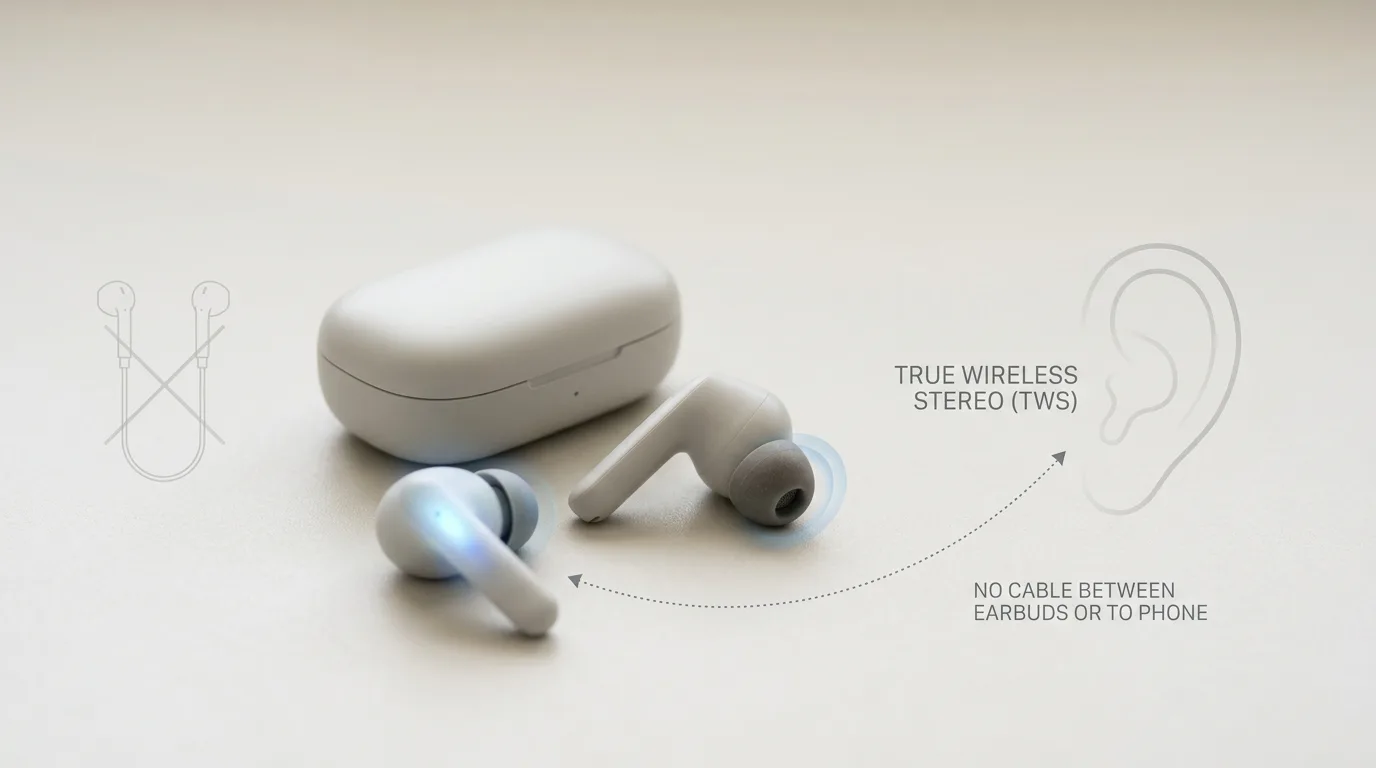
True wireless (sometimes written as TWS, for True Wireless Stereo) means there is no cable anywhere in the product — not between the earbuds and your phone, and not between the two earbuds themselves. Each earpiece is a fully independent device that connects to your phone (and to each other) purely over Bluetooth.
🎧 What "wireless" earbuds usually means instead
Plenty of earbuds are wireless in the sense that they connect to your phone without a cable, but still have a physical cord or band connecting the left and right earpiece:
Neckband earbuds: The two earpieces hang from a cord that sits around your neck.
Behind-the-neck / sport bands: Similar idea, often with a more rigid band for stability during exercise.
These are genuinely wireless from your phone's perspective — you're not tethered to your device — but they are not true wireless, because the earpieces themselves are still physically connected to each other.
🧩 Why the distinction actually matters when shopping
Losing one earpiece is a real risk with true wireless: Since nothing connects the two earbuds, a dropped or misplaced earbud is genuinely lost, unlike a neckband design where both pieces stay attached to the cord around your neck.
Charging cases are a true-wireless feature: The compact charging case that most true wireless earbuds come with exists specifically because there's no cable to double as anything else — neckband designs typically charge via a cable instead.
Battery life is split differently: True wireless earbuds run each earpiece off its own tiny battery (topped up by the case), while neckband designs often share one larger battery between both sides, which can mean longer single-session battery life at the cost of extra bulk.
🔍 How to tell what you're looking at before buying
If a product listing doesn't make it obvious, look for these signals:
Product photos showing two entirely separate earpieces with a charging case → true wireless.
Any visible cord, band or connector between the two earpieces in photos → not true wireless.
The phrase "TWS" in the spec sheet is a reliable shorthand for true wireless specifically.
This is a general terminology guide — for a comparison of actual true wireless models by battery life, ANC and other specifications, see our TWS earbuds catalog guide.
EarbudsTimeline is an independent project. If this article helped you, a free-amount donation always makes my day.
Stay in the loop
New articles and database updates, no spam.