
blog.tableOfContents
- 📞 The 1880s–1890s: telephone operator origins
- 🎧 1910: Nathaniel Baldwin and the design most people credit
- 🎵 1958: the shift to music listening
- 📻 1960s–1970s: portable "radio headphones"
- 🚶 1979: the Walkman era
- 🔇 2000: modern noise cancelling goes consumer
- 🎶 2001: earbuds go mainstream
- 📡 2016: true wireless earbuds
blog.inBrief
From 1890s telephone operator headsets to Nathaniel Baldwin's 1910 Navy design, John Koss's stereo headphones, and beyond — the actual timeline of headphone history.
When Were Headphones Invented? The Real History
There isn't one clean invention date — headphones evolved gradually from telephone-operator equipment into the consumer product we know today. Here's the timeline, with the commonly-cited "inventor" put in proper context.
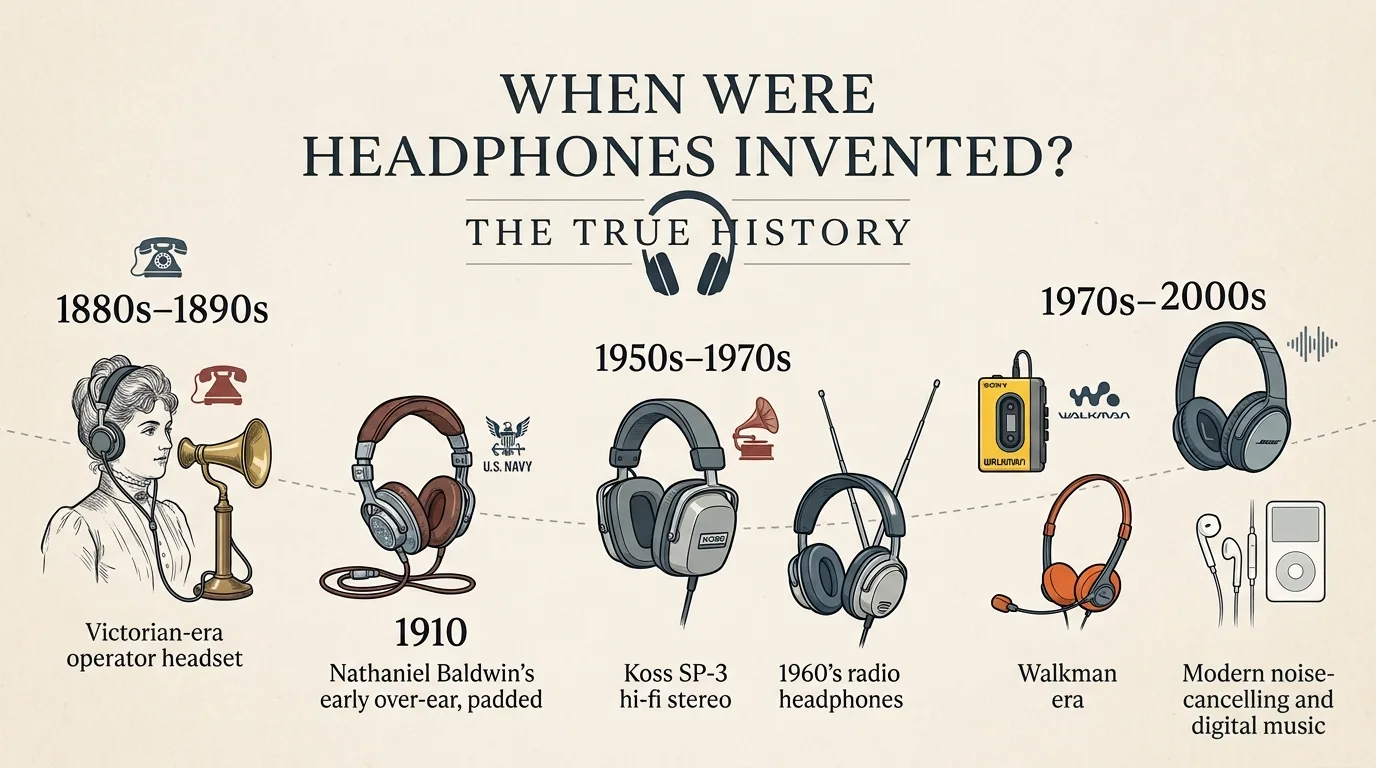
📞 The 1880s–1890s: telephone operator origins
Long before consumer headphones existed, telephone and radio operators needed hands-free listening devices. By the 1890s, the British company Electrophone had developed a listening device with two earpieces, letting subscribers listen to live theater and opera performances over telephone lines. Around the same period, French engineer Ernest Mercadier patented an early set of in-ear headphones (1891), and German company Siemens Brothers sold headpieces for telephone operators.
🎧 1910: Nathaniel Baldwin and the design most people credit
Nathaniel Baldwin, an inventor working from his kitchen in Utah, developed an improved telephonic receiver in 1910 and sold it to the U.S. Navy for radio operators. His design — using a mile of copper wire coiled inside each earcup — set the visual and structural precedent still recognizable in headphones today (the padded over-ear cup connected by an adjustable band).
Baldwin is the answer most commonly given to "who invented headphones," though it's worth noting that similar telephone-operator headsets existed years before his design (as early as 1906, based on photographic evidence from other manufacturers) — Baldwin's real contribution was popularizing and refining the format the Navy then adopted at scale, not inventing the underlying concept in isolation.
🎵 1958: the shift to music listening
Inventor John Koss built the first pair of hi-fi stereo headphones, the Koss SP-3, to demonstrate the sound quality of his portable phonograph. This is generally considered the moment headphones shifted from a functional communications tool (telephone/radio operators) toward a product built specifically for personal music listening.
📻 1960s–1970s: portable "radio headphones"
Decades before Bluetooth, wireless headphones already existed in a different form — "radio headphones" with a built-in AM/FM antenna and small speakers in each earcup, letting people carry their radio listening with them without a cord to a stereo.
🚶 1979: the Walkman era
Sony's Walkman made headphone listening a mainstream, everyday habit by pairing lightweight headphones with a genuinely portable cassette player, selling hundreds of millions of units over the following decades.
🎶 2001: earbuds go mainstream
Apple didn't invent the earbud shape — small in-ear headphones had existed since the earliest days of personal listening — but bundling white earbuds with the original iPod in 2001 made the earbud format the default choice for a generation of personal music listening.
📡 2016: true wireless earbuds
Apple's AirPods (announced September 2016, released that December) weren't the first true wireless earbuds either — smaller manufacturers had experimented with the format earlier — but they're what made cable-free earbuds mainstream, setting the template most true wireless earbuds still follow today.
Headphone history is a story of incremental improvement across many inventors and companies rather than a single "aha" moment — Baldwin, Koss, Bose, and Apple each solved a different problem at a different point in the timeline.
EarbudsTimeline is an independent project. If this article helped you, a free-amount donation always makes my day.
Stay in the loop
New articles and database updates, no spam.