
blog.tableOfContents
- 1. The early days: a market clustered around premium
- 2. Entry-level goes mainstream
- 3. Premium features trickle down to the mid-range
- 4. The premium segment still exists, but on different terms
- 5. What the EarbudsTimeline data shows
- Are wireless earbuds more expensive today than in 2016?
- Does inflation explain part of this trend?
- Can future pricing be predicted?
blog.inBrief
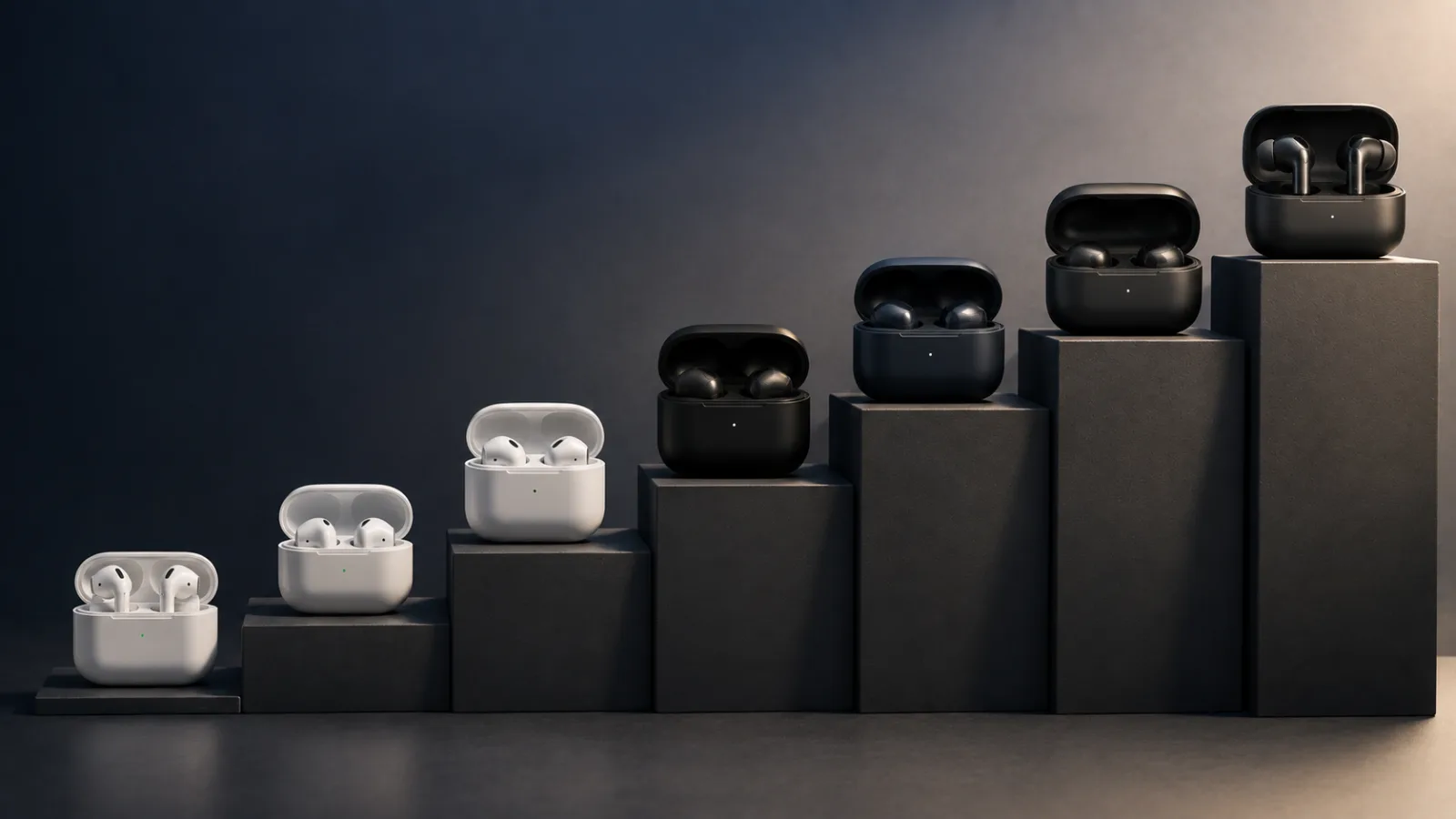
Between the democratization of entry-level models and the premium segment moving upmarket, how wireless earbud pricing has structured itself over a decade.
How Wireless Earbud Prices Have Evolved Since 2016
Since true wireless earbuds entered the mainstream, their prices haven't simply moved in one direction.
Instead, the market has become increasingly segmented. Budget models have become more accessible, mid-range earbuds have absorbed features that once belonged to premium products, and high-end models have had to find new ways to justify their prices.
1. The early days: a market dominated by premium models

When true wireless earbuds first gained widespread attention around 2016, the market was still relatively small.
There were fewer manufacturers, fewer models, and little price competition. Early products therefore tended to sit toward the premium end of the market, with buyers paying a significant premium for the convenience of going completely wireless.
At the time, simply offering a reliable pair of truly wireless earbuds was a selling point in itself.
2. Entry-level earbuds go mainstream
As more manufacturers entered the market, competition intensified.
At the same time, the cost of components such as Bluetooth chips, batteries and miniature audio hardware fell. This combination made it possible to produce capable wireless earbuds at much lower prices.
An entry-level segment gradually emerged, making true wireless accessible to a much wider audience.
These cheaper models didn't necessarily match premium products in every area, but they could deliver the fundamentals — wireless connectivity, charging cases, respectable battery life and increasingly good sound — without requiring a premium budget.
3. Premium features trickle down to the mid-range
One of the clearest changes has been the gradual movement of premium features into cheaper products.
Active noise cancellation (ANC), for example, was initially associated primarily with more expensive earbuds. Over time, it became increasingly common in the mid-range and eventually appeared in models competing at much lower prices.
The same pattern applies to features such as multipoint connectivity, transparency modes, low-latency gaming modes, app-based EQ and increasingly sophisticated companion software.
This is a familiar pattern in consumer electronics: a feature starts as a premium differentiator, competition increases, and the feature eventually becomes accessible to a much broader market.
4. The premium segment still exists — but on different terms
The continued availability of inexpensive earbuds hasn't eliminated the premium market.
Instead, it has changed what premium products need to offer.
ANC and multipoint, once useful indicators of a high-end product, are now available across a much wider range of prices. Paying more therefore increasingly means looking beyond the feature checklist.

Premium earbuds now tend to differentiate themselves through things such as more refined audio tuning, better microphones, superior ANC performance, materials and construction, spatial audio, ecosystem integration and more sophisticated software.
The question is no longer simply "Does it have ANC?"
It's "How well does it do everything?"
5. What the EarbudsTimeline data shows
Looking at the average launch prices of the models tracked by EarbudsTimeline across their release years reveals an important distinction.
The market hasn't followed a simple trajectory in which wireless earbuds have continuously become cheaper or more expensive.
Instead, it has become more segmented.
Lower-priced models have become increasingly capable and accessible, while the premium segment has remained relatively resilient. This has created a wider range of choices between the cheapest earbuds and the most expensive flagship models.
In other words, the biggest change since 2016 isn't necessarily the average price of earbuds.
It's the number of different price-to-feature combinations available to consumers.
FAQ
Are wireless earbuds more expensive today than in 2016?
It depends on the segment.
Entry-level earbuds are generally far more accessible than they were in the early days of true wireless. At the same time, premium models have remained relatively expensive, with some flagship products maintaining or even increasing their launch prices.
So there isn't a single answer for the entire market.
Does inflation explain part of this trend?
Inflation plays a role, particularly when comparing launch prices across a decade.
But it doesn't explain the whole story. Falling component costs, manufacturing scale and stronger competition have helped push increasingly sophisticated features into lower price categories.
Why can cheap earbuds offer features that used to be premium?
Because technologies become cheaper and easier to manufacture at scale.
Once a feature becomes widespread, manufacturers can incorporate it into more products, while competition makes it harder for brands to charge a large premium simply for having that feature.
That's why features such as ANC and multipoint have gradually moved down the price ladder.
Can future earbud prices be predicted?
Not with much certainty.
Competition, component costs, new technologies and consumer demand can all influence pricing.
However, one pattern has remained remarkably consistent: features that begin in expensive products tend to become more accessible over time.
Conclusion

Since 2016, the wireless earbud market hasn't simply become more expensive or more affordable.
It has fragmented into increasingly distinct segments.
Entry-level earbuds have become more accessible and dramatically more capable. Mid-range models now offer many features that once required a premium budget. And high-end earbuds continue to justify their prices through improvements in sound, noise cancellation, hardware, software and overall refinement rather than through basic features alone.
The underlying trend is clear: once-premium features keep trickling down to lower price points, while competition continues to give consumers more choice at almost every budget.
Want to follow this evolution in detail? Explore pricing trends, brand by brand, on the Timeline.
EarbudsTimeline is an independent project. If this article helped you, a free-amount donation always makes my day.
Stay in the loop
New articles and database updates, no spam.