
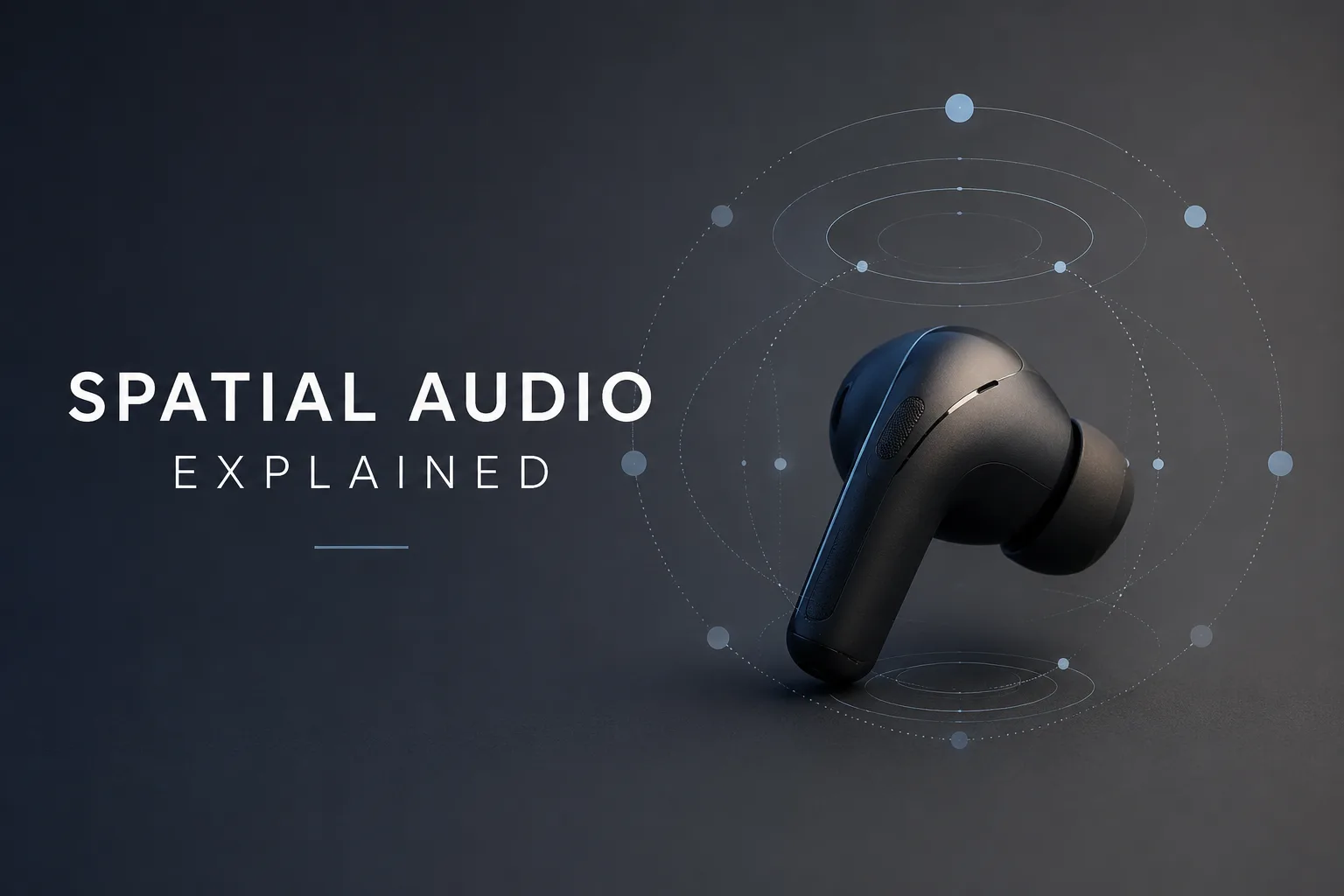
Spatial Audio Explained — What It Actually Changes When You Listen
blog.tableOfContents
- 1. Stereo gives you left and right. Spatial audio tries to give you a place.
- 2. How your ears tell your brain where a sound is
- 3. HRTFs are one of the keys to making it work
- 4. Spatial audio isn't one single technology
- Channel-based audio
- Object-based audio
- Scene-based audio
- 5. Native spatial audio and spatialized stereo aren't the same thing
- 6. Head tracking changes the relationship between you and the sound
- 7. Why some spatial audio sounds like it's outside your head — and some doesn't
- 8. Your brain also uses the room around a sound
- 9. The content still matters
- 10. The streaming service and device are part of the experience
- 11. Why spatial audio sounds different from one person to another
- 12. Does spatial audio actually sound better?
- FAQ
- Does spatial audio work with stereo music?
- Do I need special earbuds for spatial audio?
- Is head tracking necessary?
- Why does spatial audio sometimes sound worse than stereo?
- Does spatial audio use more battery?
- Is Dolby Atmos the same thing as spatial audio?
- Is spatial audio useful for gaming?
- The bottom line
blog.inBrief
Spatial audio is now everywhere in wireless earbud specifications. You'll see it alongside terms such as Dolby Atmos, 3D audio, immersive audio, or dynamic head tracking.
Spatial audio is now everywhere in wireless earbud specifications. You'll see it alongside terms such as Dolby Atmos, 3D audio, immersive audio, or dynamic head tracking.
But spatial audio isn't simply a wider version of stereo.
It is a family of techniques designed to make your brain perceive sounds as coming from specific positions in three-dimensional space — including left and right, but also in front of you, behind you, above or below you, at different distances, and sometimes even moving around you.
The important part is that the earbuds don't create this effect on their own. The final result depends on the audio content, the rendering technology, your device, the software processing it, and even the shape of your ears and head.
Here's what is actually happening when you turn spatial audio on.
1. Stereo gives you left and right. Spatial audio tries to give you a place.
Traditional stereo works with two channels: left and right.
By changing the relative volume and timing of a sound between those channels, a recording can make a guitar appear to come from the left, a vocal from the center, or an effect from the right.
Spatial audio goes further.
Instead of only deciding which ear receives more of a sound, a spatial renderer attempts to reproduce the acoustic cues your brain normally uses to determine where a sound exists in the real world.
That can include:
- horizontal direction
- elevation
- distance
- movement
- the acoustic character of the surrounding space
The goal isn't simply to make the soundstage bigger.
The goal is to make the sound appear to occupy a position in space.
2. How your ears tell your brain where a sound is
Your brain is constantly comparing what reaches your two ears.
If a sound comes from your right, for example, it reaches your right ear slightly earlier and generally at a different level than it reaches your left ear. These differences provide important localization cues.
Two of the fundamental ones are:
ITD — Interaural Time Difference: the difference in arrival time between your ears.
ILD — Interaural Level Difference: the difference in sound level between your ears.
Your brain combines these cues with changes in the sound's frequency spectrum caused by your head and outer ears.
Spatial audio attempts to reproduce these cues electronically.
This is one reason spatial audio can work through only two earbuds: you don't physically need speakers above, behind, and in front of you if the audio system can reproduce the cues your brain expects from those positions.
3. HRTFs are one of the keys to making it work
One of the most important concepts behind headphone-based spatial audio is the HRTF, or Head-Related Transfer Function.
Your head, torso and especially your outer ears naturally filter incoming sound. The exact changes depend on where the sound comes from.
A sound coming from above doesn't reach your ears in exactly the same way as a sound coming from directly in front of you.
Your brain learns to interpret these changes as spatial information.
An HRTF models those transformations so that a renderer can apply them to audio and simulate a sound arriving from a particular position.
This also explains an important limitation of spatial audio:
there is no single HRTF that is perfect for everyone.
People have different ear shapes, head sizes and physical characteristics, so the same spatial processing can sound convincing to one listener and less convincing to another.
That's one reason personalization can matter.
4. Spatial audio isn't one single technology
"Spatial audio" is an umbrella term rather than one specific technical format.
Different systems can use different approaches to represent and render a spatial scene.
Channel-based audio
Sounds are assigned to predefined channels.
Traditional stereo is the simplest example. Surround formats such as 5.1 and 7.1 extend this approach by adding more speaker channels around the listener.
Object-based audio
Instead of permanently assigning a sound to one channel, individual sounds can be treated as objects with positional information.
A renderer can then decide how those objects should be reproduced for the listener's particular setup.
This is particularly useful for interactive media because sounds can move through the virtual environment rather than being locked to fixed channels.
Scene-based audio
Another approach represents the spatial sound scene as a whole rather than as a collection of fixed channels or individual objects.
Ambisonics is an important example of scene-based spatial representation and can be decoded for different playback configurations.
For an earbud buyer, the important takeaway is simple:
Two products can both advertise "spatial audio" while using very different technologies underneath.
5. Native spatial audio and spatialized stereo aren't the same thing
This distinction is particularly important.
Some content is produced specifically for a spatial format. During production, engineers can position individual elements within a three-dimensional scene.
Other systems take ordinary stereo content and process it afterward to create a more spacious or three-dimensional impression.
Both approaches can sound spatial.
But they aren't equivalent.
A native spatial mix contains spatial information created as part of the production itself. A spatializer starts with an existing signal and attempts to create spatial cues from it through processing.
So when an earbud manufacturer says that its spatial audio works with stereo content, that doesn't necessarily mean your stereo library has suddenly become equivalent to a native spatial mix.
The renderer matters.
6. Head tracking changes the relationship between you and the sound
Head tracking is one of the most noticeable differences between basic and more advanced spatial implementations.
Without head tracking, the virtual sound scene generally follows your head.
Turn your head to the right, and the entire perceived scene effectively turns with you.
With head tracking, sensors detect the orientation of your head and the renderer updates the audio accordingly.
Imagine a person speaking in front of you.
You turn your head to the left.
With head tracking, the voice can remain anchored in front of you rather than moving with your earbuds. The brain receives a change in the spatial cues that is consistent with what would happen in the real world.
This can make the virtual scene feel more stable and externalized.
Research summarized in the source material also indicates that active head movement and head tracking can improve localization and reduce certain front/back confusions, although the benefit depends on the playback system and listening conditions. That's why "spatial audio" and "spatial audio with head tracking" should not be treated as identical features.
7. Why some spatial audio sounds like it's outside your head — and some doesn't
One of the biggest challenges with earbuds is externalization.
With conventional headphones, sounds can feel as though they are located inside your head, even when the recording contains stereo information.
A convincing spatial renderer tries to make the sound appear to exist outside the headphones, at a position in the surrounding environment.
HRTF accuracy, head tracking and the way the virtual acoustic environment is rendered all influence this effect. Poor HRTF matching or an incomplete rendering chain can make spatialization feel less natural.
This is also why simply adding more reverb isn't a universal solution.
More echo does not automatically mean more realism.
The renderer needs to reproduce the right combination of direct sound, reflections and reverberation.
8. Your brain also uses the room around a sound
In the real world, you don't locate sounds using direction alone.
Your brain also uses reflections and reverberation to understand the environment.
Early reflections can contribute to the perception of spaciousness and proximity, while later reverberation provides information about the size and characteristics of an acoustic space.
Spatial audio systems can therefore simulate more than the position of a sound.
They can also simulate some of the acoustic environment surrounding it.
That's part of what can make one spatial implementation feel like a convincing room while another simply sounds like heavily processed stereo.
9. The content still matters
Spatial audio processing cannot manufacture unlimited spatial information.
The biggest difference is between content that was specifically produced for spatial playback and content that is being spatialized after the fact.
For native spatial content, the production process can define where voices, instruments, effects and ambience should exist in the virtual scene.
For stereo content, a renderer has to infer or simulate spatial relationships from the existing two-channel signal.
This means the same earbuds can produce dramatically different results depending on what you're listening to.
A spatial mix can make the difference obvious.
A poorly processed stereo track may simply sound wider, more reverberant, or less focused.
And sometimes, regular stereo can actually sound better.
Spatial audio is not automatically an upgrade.
10. The streaming service and device are part of the experience
Buying earbuds with a spatial-audio specification is only one part of the equation.
The complete playback chain can involve:
Content → streaming service → operating system → device → spatial renderer → earbuds
If one part doesn't support the required format or processing, the experience can change.
This is why compatibility should always be checked at the system level rather than simply looking for a "Spatial Audio" label on the earbuds.
The broader spatial-audio ecosystem also depends on hardware capabilities, rendering software, content availability and interoperability between platforms.
11. Why spatial audio sounds different from one person to another
This is easy to overlook.
Your ears are part of the audio system.
The shape of your outer ears, your head and your torso affects the way sound reaches your eardrums. Those physical differences influence the acoustic cues your brain uses for localization.
As a result, the exact same HRTF or spatial renderer won't necessarily produce the same perceived position for everyone.
This helps explain why one person might find a spatial mode incredibly convincing while another hears mostly a wider or more processed stereo image.
Head-tracking latency can also affect the result. If the audio scene doesn't respond naturally to head movement, the illusion becomes less convincing.
12. Does spatial audio actually sound better?
Not necessarily.
It can provide:
- a stronger sense of immersion
- clearer separation between spatial elements
- more convincing front/back positioning
- a greater sense of height
- a more stable sound field when head tracking is available
- a stronger feeling that sounds exist outside the earbuds
- unnatural processing
- reduced clarity
- an exaggerated sense of space
- localization errors
- an inconsistent experience between listeners
So the best spatial implementation isn't necessarily the one with the most aggressive effect.
It's the one that makes the virtual scene feel natural and believable.
FAQ
Does spatial audio work with stereo music?
Yes, depending on the system.
Some spatial-audio implementations can process stereo content and create a more three-dimensional presentation. However, spatialized stereo doesn't necessarily contain the same positional information as content specifically produced for a spatial format.
Do I need special earbuds for spatial audio?
Not necessarily special earbuds, but you need a compatible playback chain.
Support can depend on the earbuds, firmware, device, operating system, application, renderer and — for dynamic spatial audio — available head-tracking hardware.
Is head tracking necessary?
No.
Spatial audio can work without it.
But head tracking can make the virtual sound field feel more stable because the renderer can respond to changes in your head orientation.
Why does spatial audio sometimes sound worse than stereo?
Because spatial processing is not automatically more accurate.
HRTF mismatches, excessive processing, rendering limitations and the characteristics of the content can all affect the result. Individual listeners can also perceive the same spatial processing differently.
Does spatial audio use more battery?
Generally, additional signal processing and active head tracking can add computational work, so there can be some additional power consumption. The exact impact depends on the implementation.
Is Dolby Atmos the same thing as spatial audio?
Not exactly.
Spatial audio is the broader concept. Dolby Atmos is one technology/ecosystem used to create and distribute immersive audio content.
The terms shouldn't be treated as interchangeable.
Is spatial audio useful for gaming?
It can be particularly useful in games because positioning sounds around the player can provide information about what's happening outside the player's field of view.
Head tracking can add another layer by making the audio scene respond to the player's head orientation. The source material identifies gaming and interactive media as important applications for head-tracked spatial audio.
The bottom line
Spatial audio isn't simply stereo with more speakers.
It's a collection of techniques designed to reproduce the acoustic cues your brain uses to understand where sounds exist in three-dimensional space.
HRTFs help simulate how your head and ears shape incoming sound. ITDs and ILDs provide important left/right localization cues. Reverberation and reflections can provide information about the surrounding environment. And head tracking can make the virtual scene respond naturally when you move. But the earbuds are only one part of the equation.
The content, renderer, device, software, head tracking and even your own anatomy all influence what you actually hear.
That's why two pairs of earbuds can both advertise "Spatial Audio" and still deliver very different experiences.
Looking for earbuds that support spatial audio? Explore our spatial audio guide to compare compatible models and see which ones include features such as head tracking.
EarbudsTimeline is an independent project. If this article helped you, a free-amount donation always makes my day.
Stay in the loop
New articles and database updates, no spam.